
Laser Safety Glasses: Choosing Goggles for a Class 3B Laser Pointer
Own a class 3B laser? Then you need proper laser safety glasses. Learn to read wavelength ratings and OD numbers, spot "green laser glasses" that protect nothing, and get the fit right.
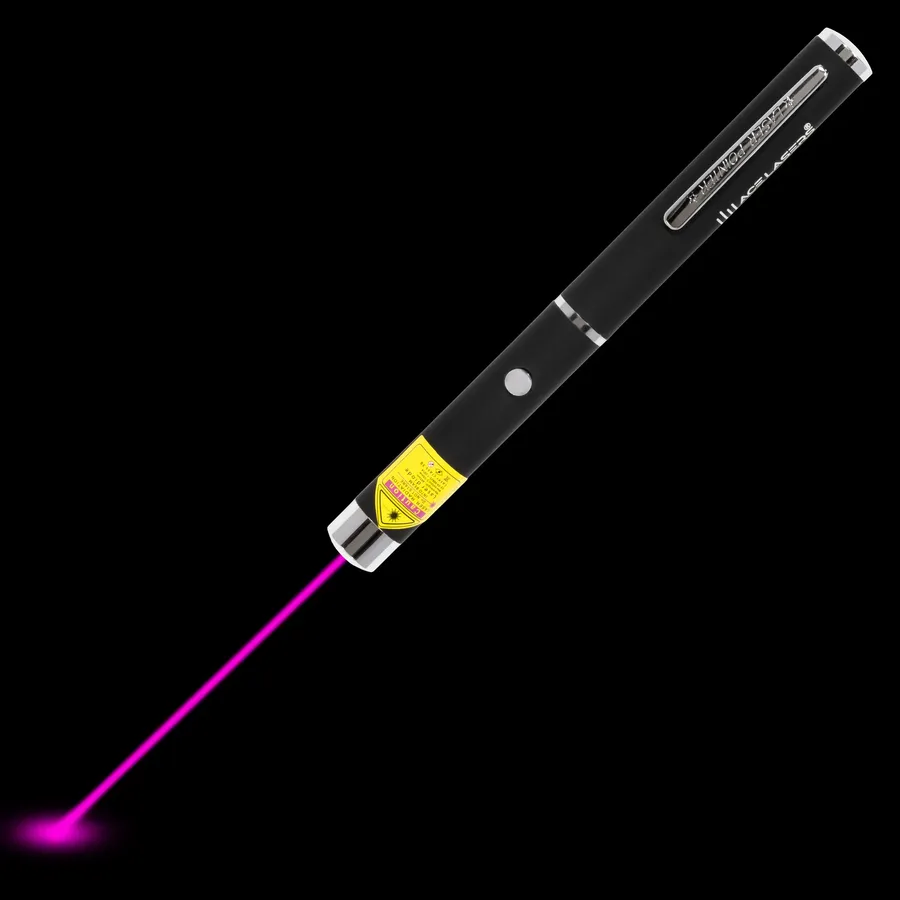
Buying a class 3B laser and skipping the goggles is like buying a chainsaw and skipping the gloves. Laser safety glasses guard your eyes while you test and set up, during demonstrations, and against that one stray flash off a puddle in the yard, a window or a gate. The trouble is that shopping for them is confusing. Some glasses protect; others only make the beam look brighter. A rating for one colour can be useless against another. And labels such as "OD 4+" rarely come with an explanation. This guide walks through the choices in the order you should make them.
First, why bother?
A class 2 pointer, below 1 mW, is normally harmless for a brief accidental glance because your blink reflex kicks in quickly enough. Class 3B is a different league. Our ACE lasers span 5 to 500 mW, and in that range a direct beam or a mirror-like bounce can damage the retina before you have time to blink. There may be no pain at the moment it happens, and the damage can last a lifetime.
Good habits come first: never aim at people, animals, vehicles or aircraft, and keep reflective surfaces out of the path. Glasses are your backup for the day something unexpected happens.
Choice 1: the right wavelength
A laser filter is tuned to a particular band of colours: it absorbs or reflects those and lets others pass. A lens that stops 532 nm green can be almost clear to 405 nm violet. So the very first thing to check is that the glasses cover your laser's wavelength:
- Green ACE lasers such as the AGP-3 Pro and the AG-1: 532 nm.
- Violet ACE lasers, namely the AVP-1 Pro, the AV-1 and the VEX-1000 Pro: 405 nm.
- Red ACE lasers, the ARP-1 Pro, ARP-2 Pro Mini and AR-1: 650 nm.
Some eyewear covers several bands at once. If your collection includes more than one colour, work through each wavelength and compare it with what is printed on the frame or filter.
Choice 2: enough optical density
Optical density, written OD, tells you how much the filter weakens light at its rated wavelength. The scale is logarithmic. OD 1 passes 10% of the light, OD 2 passes 1%, OD 3 passes 0.1%, and each extra point divides by ten again. For high-power class 3B lasers, eyewear makers usually recommend a much higher OD than for low-power ones; the supplier should be able to tell you which OD matches the maximum output of your particular laser.
Expect a high-OD filter to look dark in its own colour. Wearing green-blocking glasses, a green dot should become dim or vanish altogether. If instead you can still see a bright green spot clearly, that is a warning sign: double-check whether the glasses really are rated for your laser.
Choice 3: proper markings
Real laser protective eyewear is labelled with the wavelength range it covers and its protection level. Here in Ireland, as elsewhere in Europe, you will usually see eyewear tested and marked to the EN 207 standard. Treat glasses that only mention a colour ("suitable for green lasers") with suspicion if they give neither a wavelength nor a rating. If nothing is marked, assume nothing is protected.
The trap: glasses that make lasers look brighter
A search for "green laser glasses" turns up lots of laser enhancement glasses. Builders use them to see the line from a green laser level more easily on a bright site: the tint lets green through while darkening the rest of the scene. They offer no protection against a laser beam whatsoever, and by darkening everything except green they can make matters worse. Sunglasses are no substitute either. Only eyewear rated and labelled for laser protection at your wavelength is worth wearing.
Choice 4: a fit you will actually wear
- Go for side shields or a wraparound shape, because reflections often come in from an angle.
- Glasses wearers should choose an over-spectacles design that sits comfortably on top of their own frames.
- Check there are no gaps at the brow or the temples.
- Pick something comfortable; a pair that pinches tends to live on the dashboard of the jeep instead of on your nose.
When they go on
- Fitting batteries, testing or adjusting the laser.
- Demonstrating near other people or anything shiny.
- Working near water, glasshouses, vehicles, metal sheds or gates.
- Standing beside the operator while birds are being moved.
A word for astronomers: once you have laser protective glasses on, your own green beam will be invisible against the sky. That is why star guides depend mostly on routine: the button is only pressed when the laser already points well up into the sky, away from the group, and the beam is never brought down towards the horizon. Wear the glasses while setting up, and any time the beam might come near eye level. Our astronomy laser pointer page describes the whole routine.
Looking after them
Scratches, cracks and heat all degrade a filter. Store your glasses in a hard case, clean them as the maker recommends, and replace them if the filter is damaged. Keeping one pair permanently with each laser means they are always to hand.
Goggles protect you, not everyone else
Your glasses cut the risk for one person: the one wearing them. They do nothing for a walker across the field, a driver on the road behind the ditch or a pilot overhead. So the core rules never change. Keep the beam off people, animals' eyes, vehicles and aircraft; keep it low for bird work and high for astronomy; keep it away from children; and lock it up afterwards. We sell ACE lasers to adults over 18 and businesses, and keeping within Irish law is the buyer's responsibility.
Shopping checklist
- Marked wavelength matches your laser: 532 nm green, 650 nm red, 405 nm violet.
- Protection level is suitable for your laser's maximum output; ask the supplier if unsure.
- Labelled as laser protective eyewear (EN 207, for example), not as "enhancement" glasses.
- Side protection and a snug fit, over prescription glasses if needed.
- Filter in good condition, stored in a case, one pair per laser.
For general advice, see our laser safety guide. To understand output levels, read our guide to milliwatts and laser classes.
More articles
Blog1000 mW Laser Pointers and the Hunt for the Most Powerful Laser: What Milliwatts and Classes Really Mean
Ads for 1000 mW or "1 watt" laser pointers are everywhere. Before you believe the number, find out what a mill…
Laser Bird Deterrent on Irish Farms: A Routine for the Whole Year
How tillage and grassland farmers can fit a green laser bird deterrent into the farming year: the problem bird…
Green vs Red Laser Pointer: How Far Green, Red and Violet 5–500 mW Lasers Really Reach
Green or red, and how far will it go? We compare green, red and violet ACE lasers by day, at dusk and after da…